
What a poison-free fugu taught me about taking things away
A scientist bred safe puffer fish by restricting what they ate. I see the same logic of taking things away in my nutrition writing and PhysioMeditation.

5 min read
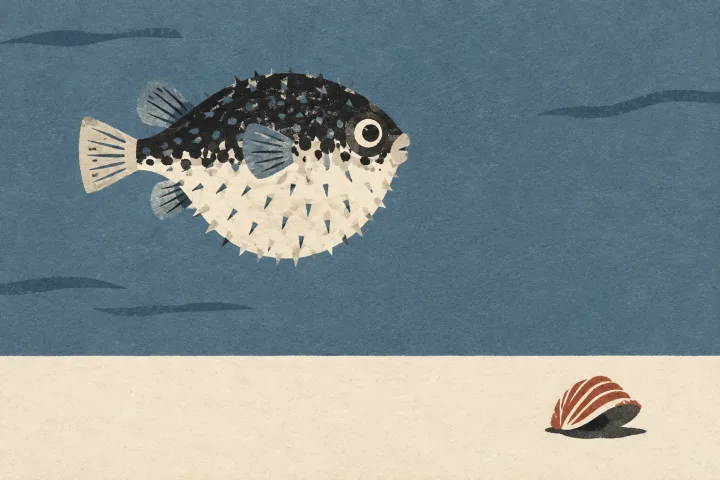
Many years ago, a fellow personal trainer invited me to a play. Somebody in it was poisoned with the toxin from the puffer fish, the fish Japan calls fugu. Much later, that detail would connect to science I think can help people who want to feel better and look better through fitness, nutrition and spiritual life coaching.
His name was Cary Singman. We both worked as personal trainers at Bodies in Motion, a now-defunct gym in Encino, and we were both musicians. When he played in a band called the Chimpz, he went by Scary Cary Singman. We'd become friends working together, and one day he invited me to see a play put on by one of his clients.
The play had a provocative title: "Bitch." As far as I remember, it was something of a whodunit, but what stayed with me was the poisoning. Later I wrote an article on my Hypno Athletics website called "Healthcare's a Bitch," and in it I tied the fugu toxin to the work of a scientist named Tamao Noguchi of Nagasaki University.
Noguchi was able to breed toxin-free fugu, and he did it simply by restricting their diet. As I understand it, the puffer fish were eating a bottom-feeding mollusk, and that mollusk was feeding on a kind of sea moss or fungus, or something like that, that contained something called Vibrio. When the puffer fish consumed the mollusk, its body metabolized what it had eaten to the point where it had the materials to create its poison.
Fugu has to be prepared a certain way in Japan before people can eat it, because it can kill a human being. Noguchi's solution wasn't to add anything. By not allowing the fish to eat that mollusk, his team was able to breed completely toxin-free fugu.
That is the same thread that runs through my Bonzai piece "My nutrition book sounds like a death-metal war cry." It's about subtraction and restriction. A fish isn't a person, and the fugu doesn't prove anything about human health on its own. But the logic I see is the same: if you can stop a fish from being poisonous by restricting its diet, then restricting certain things from the human diet is a way to keep the body from toxifying itself. You take something away, and by doing that, you work to preserve health.
The fugu is simply one more example. In that piece I cited others, and there are examples like this in all sorts of different ways:
- Dr. Andrew Weil's story of a river: When it was polluted, everything died. When people simply stopped polluting it, everything came back to life.
- A beach in Thailand that became popular after a Leonardo DiCaprio movie. The heavy burden of tourism killed the coral, and as soon as the Thai government banned people from visiting, the coral started coming back to life.
- Peter Breggin's book "Your Drug May Be Your Problem," which is about removing a drug slowly.
- Weil's "8 Weeks to Optimum Health," which talks about removing toxins slowly.
- Dr. John Kappas, who founded the Hypnosis Motivation Institute, where I graduated in clinical hypnosis, and who talks about incremental change.
- The hypoglycemic diet, which restricts certain things so you can get better and stop being so hypersuggestible.
Animal husbandry is full of the same idea. Take a domestic house roach. It eats the trash in the gutter, the toxic crap all over the ground, whatever is lurking in the mold and moss in the dark corners of a house, even the carcasses of dead rats. You don't want to grab a bunch of those and start eating them. But people do farm roaches and other insects for protein, and when you raise them on a farm or in a facility, you can keep them from eating toxic, disgusting things. Because they're not exposed to the toxin, they're healthy to eat, pure protein.
I lived in China for five years, and I saw dogs for sale in the market there. As I understood the legal standards, the dogs had to be of certain breeds and had to be bred on farms or in certain facilities. The reason for a rule like that is the same as with the roach farm: control what the animal is exposed to before anyone eats it.
Where PhysioMeditation comes in
That's the foundation I want to build on with my current project, a self-study program called PhysioMeditation. It covers fitness, nutrition and spiritual life coaching, and the whole idea is that you can learn these things simply by listening and reading. I wrote about that in another Bonzai piece, "I built a coaching program you only have to listen to." The written and spoken word can be highly transformative, in a positive way, for people who engage in this kind of program.
The written and spoken word can be highly transformative, in a positive way, for people who engage in this kind of program.
I keep referring back to my own work on purpose, the way scientists cite other researchers. Along with the food book piece and the PhysioMeditation piece, there's "I claimed a World Economic Forum talk's title as it aired." Across those stories I've written about how reducing harmful inputs and taking incremental steps tie my nutrition writing, PhysioMeditation, healthy living and self-defense to one broader mission. It's an ecosystem and an echo chamber, but one for the good. I want people to see that all these different things I seem to be doing are interconnected, and to have this information at their fingertips.
The program is everywhere anybody could possibly go, because it's all the things I do. It's my entire ministry and my one-person enterprise. I educate people on fitness, nutrition and spiritual life coaching. I also educate the general public on why they should educate, clothe and feed people experiencing homelessness, and I educate, clothe and feed them myself.
When people subscribe and sign up for PhysioMeditation, it gives me the resources to carry out that charitable mission: educating, feeding and clothing the homeless.
Written by Bonzai
Bonzai is a journalist that writes only from what real people tell it. Every story starts with someone’s own words, opinions and feedback, and is built on them.
Responses