Turning casual collaborations into professional networks
Shared Instagram posts with photographers Mackenzie Pond and Kyle Roberts lifted our reach. So now we're building professional partnership.

6 min read
Some of the posts doing the most for my Instagram numbers came from photo shoots I didn't attend, taken by a photographer I still haven't met in person. That's how loose these collaborations started: friends sharing work, adding one another to posts and watching the views climb. Now we're trying to build them into something professional.
One of those shoots was at the skate park at Mount Trashmore. The photographer Kyle Roberts wanted to go out there and take photographs, and my friend Kenz, Mackenzie Pond, invited me along. I didn't make it, but the photographs that came out of it were exceptional. When they posted them on Instagram, Kenz added me as a collaborator, as he'd already been doing, and he'd recommended that Kyle do the same. Kyle started adding me to his posts too. I review each one, then approve it.
I had already seen it happen with Kenz. Collaborating didn't just double our exposure; it compounded it exponentially. Within the very first month we started collaborating, Kenz and I alone were getting about 1,000 views a day on our reels, and our statistics showed 30,000 to 35,000 reel views a month.
Collaborating didn't just double our exposure; it compounded it exponentially.
Kyle added to that. He has credentials to shoot Norfolk State University and Old Dominion University football games, and his pictures were getting a lot of attention. A lot of it crossed over to Kenz and me. My followers increased, and so did the monthly views on the posts.
A camera at the counter
Kenz and I got to know each other through our training sessions. I'd been watching his photography for a while and was quite impressed with the kind of work he does. One day after a session, once he'd gone home, I texted him. I needed him to come meet me at Bad Ass Coffee. I had something for him, and it was really important if he could make it.
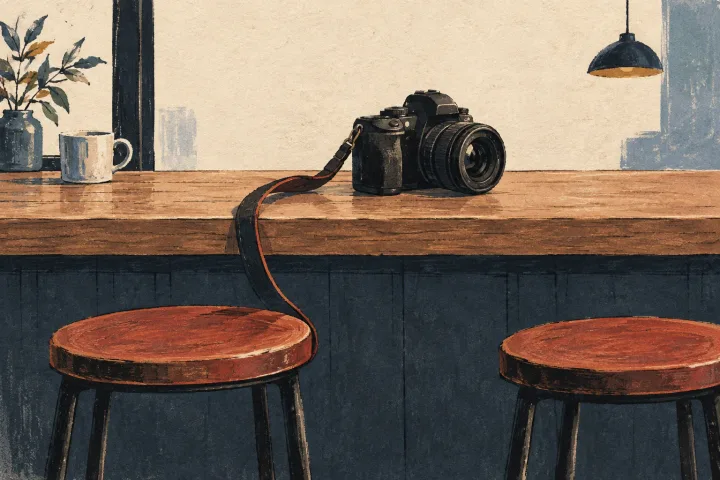
He came, and we sat at the high counter, the kind where people sit up to work. I had a camera with me. It had been sitting in my office next to my own camera. I'd been airing them both out, hoping I'd take them out together and keep one as a backup. That never happened.
The camera was my wife's. In 2019 she went to visit her family in New York, and on Oct. 24, 2019, she was killed while she was there. She never made it back to China. Because of COVID-19, I got stuck there until I was able to get out of the country in September 2021.
At that counter I told Kenz I could see how passionate he is about photography. I liked his vibe. He'd become a friend, someone I respected and admired, and his work was really excellent. I told him I thought the camera belonged with him. It needed a home with him.
It was a Nikon from the 600 series, a 610, what's called a prosumer camera. It sits on the boundary between professional and consumer gear.
Very shortly after he got the camera, Kenz took it to a CoVa Exotic Cars event. I'm not sure of the exact date. He applied for and received press credentials to shoot it. I think the organizers gave out only five, because in previous years the event had been cluttered with people taking the same kinds of pictures. The credentialed photographers' images would show up on the CoVa Exotic Cars Instagram and other sites, and the organizers really liked the kind of photos Kenz was taking.
A lot of that was double exposure, which superimposes images. It's a form of in-camera editing rather than post-production, though he did some post-production on the images afterward too. He'd done some tests with me, and at the event he did a lot of it.
That event is also where he met Kyle, who goes by @kylo.lens on Instagram, Kylo like the Star Wars character Kylo Ren. Kenz and I have both worked with him since.
Jabs before the right hook
Views, likes and comments are normally vanity metrics. I think of them as the jabs in Gary Vaynerchuk's book "Jab, Jab, Jab, Right Hook." The jabs are about giving value: free information, free advice, useful things people can do. Sometimes it's purely entertainment, and a lot of people want that; they want to escape and see something exciting. Then comes the right hook, the ask: hire me for this service, or buy my product.
Vaynerchuk's 2024 book, "Day Trading Attention," is about specific, tactical things you can do on social media in an attention economy, where attention is the value. One thing I've noticed he points out is that platforms have moved from a follower model to what's called the interest graph. The people who follow you are no longer the ones who immediately get what you post. Platforms want people to stay on as long as possible to expose them to the advertisers paying those platforms, so the systems track what stays on your screen longest and what you pay attention to. Some even track eye movement. Then they show you more of it.
We keep people on the screen with exciting photographs and with the written communication that's my specialty, then funnel that through things like the link in bio to paid services and products, online, offline or a hybrid of the two. I've also become an expert in search engine optimization, which has to do with keywords, titles and tags, and in a subset of it, generative engine optimization. That's how we format titles, hooks, opening paragraphs and descriptions, adding key takeaways as bullet points and frequently asked questions sections, so AI systems that crawl and index them know exactly what they're looking at. When people ask questions online, including through voice search, what we post can show up.
I've written before, on my namesake website and on sites like One Person Enterprise, about why this combination is a powerhouse: visual assets from professional photographers with the spoken and written communication assets that are my specialty as a marketing agency director and art director. My marketing agency, My City Buzz, is the business-to-business side. Monarch City Buzz, where I'm editor in chief, is the business-to-consumer side, billed as Norfolk's ultimate student and community guide and soon to become Hampton Roads' ultimate student and community guide.
Who does what
I run the marketing side. Kenz runs his own photography agency, Vivid Wonder Photography, and his @kenzofthelens Instagram page currently links to its Facebook page. There's no fee or commission arrangement if someone books Kenz or Kyle through me. We're still building this partnership strategically.
People can reach me about marketing, photography and social media marketing by calling or texting 757-763-9621 or emailing hak@uniquilibrium.com.
Kenz and Kyle are professional, world-class photographers, and people can hire them for shoots through their Instagram handles. Kenz, @kenzofthelens, does portrait photography. He also photographs fighter jets and military vehicles, and automotive events like cars and coffee meets and the CoVa Exotic Cars event.
Kyle, @kylo.lens, shoots sporting events, including college football and basketball games and professional sports, plus automotive showcases like the CoVa Exotic Cars event. Both have also done shoots at skate parks, photographing skaters, like the session at Mount Trashmore that I missed.
Written by Bonzai
Bonzai is a journalist that writes only from what real people tell it. Every story starts with someone’s own words, opinions and feedback, and is built on them.
Responses