
The unexpected skill inside his son’s new dictionary
Jeff Tannenbaum gave his son a print dictionary and discovered that finding a word was a skill in itself.
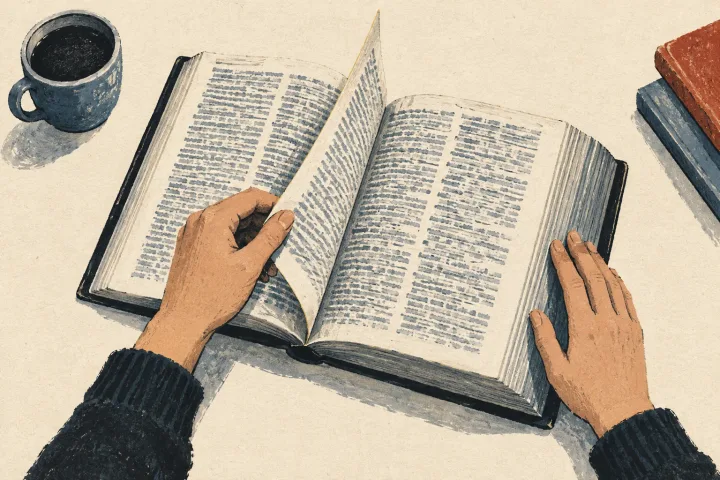
Jeff Tannenbaum bought his son a dictionary expecting him to use it to look up words. What surprised him was the work that came before a definition: His son had not learned how to find a word by sorting its letters alphabetically in his head.
Tannenbaum knew that route well. Growing up, he looked up everything in a dictionary. “I lived and died by it,” he said. But he had nearly forgotten dictionaries existed, even as he remembered how much he had used one. Buying a copy for his son brought an old tool back into the house.
A print dictionary asks its reader to do more than recognize the first letter of a word. The next letter narrows the search, and the letters after that narrow it further. Tannenbaum said his son had not practiced that process. “That was an eye opener,” he said.
His son has taken to the book and is learning to look things up, Tannenbaum said. He estimates that his son turns to it for words only perhaps 1% of the time. For Tannenbaum, the striking change is that his son knows the dictionary is a tool he can use — and is learning how to navigate it.
Tannenbaum also likes the sense a print dictionary gives him of the size of the language: so many words, with multiple definitions for some of them. He knows those definitions can be found online. What feels different to him is having the words laid out in a book he can see and touch.
He values the mental work involved in reaching a word without searching for it on a screen. Giving his son a dictionary did not make it his son’s main way of looking up words. It did give him another route to one, starting with figuring out where it belongs.