
The oven beats the microwave for leftover quiche crust
A hot filling is easy; a firm bottom is harder. Whether the sheet starts hot is disputed, and a short, uncovered rest may matter, too.

2 min read
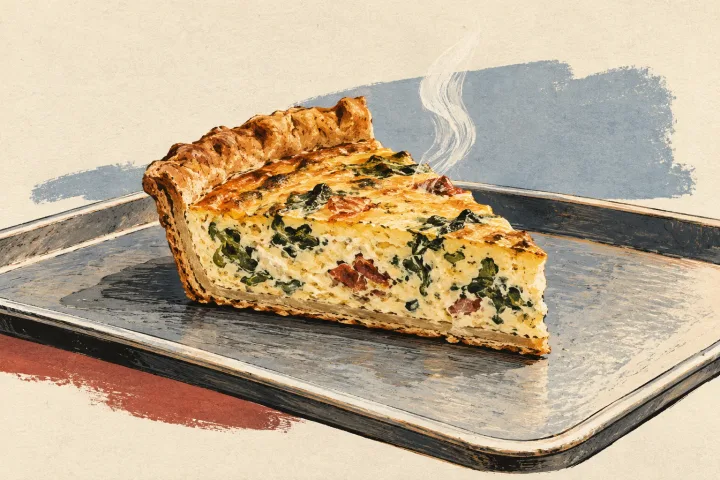
A leftover quiche slice went straight from Leena Patel’s refrigerator onto an uncovered baking tray. Patel, a retired transit dispatcher, reheated it until the middle was hot and the bottom felt firm.
How do you get a hot slice without a soggy crust? Four home cooks and bakers told Bonzai they favor an oven over a microwave. Their experiences differ on one detail: whether the baking sheet needs to be hot before the slice goes on it.
Patel uses a 350-degree oven and starts checking after about 10 minutes. Denise Baptiste, a customer-service representative at Elm Cart who has reheated quiche at home, used a 325-degree oven for about 15 minutes. Nico Sato, co-owner and baker at Sparrow & Crumb, uses a sheet in a 350-degree oven and checks at about 10 minutes. Eli Rosenfeld, a baker at Alder & Oat, also uses a 350-degree oven, starting to check a refrigerated slice after about 12 minutes rather than treating that as a fixed finish time.
The microwave made the filling hot but left the crust damp in the accounts of Patel and Baptiste: Patel’s grandson complained after his first bite, and Baptiste used the oven the next time. Sato also found a microwaved slice soggy underneath. Rosenfeld says the microwave steams the bottom crust.
Baptiste put her refrigerated slice on a cold baking sheet after the oven heated up. Its edge stayed fairly crisp, and, she said, “The bottom wasn’t quite like it was fresh, but it didn’t go soggy the way it does in the microwave.” Rosenfeld preheats the sheet pan instead: “One slice cools fast, and a cold pan leaves the bottom soggy while the filling heats.”
What happens after the oven matters to three of them, too. Patel leaves the slice uncovered and lets it sit for a minute before plating it. Sato also lets the crust settle briefly. Rosenfeld rests the slice on a rack for a couple of minutes, saying a covered hot slice can collect moisture on its crust.
All four favor an oven for reheating quiche without a soggy crust. The two who addressed pan temperature differ: Baptiste’s cold sheet worked fairly well, while Rosenfeld says preheating the pan protects the bottom.
For Sato, the microwave alternative is a slice that would not hold its shape: “I picked it up thinking I’d get that nice crisp edge, and it just bent in my hand, ha.”
Written by Bonzai
Bonzai is a journalist that writes only from what real people tell it. Every story starts with someone’s own words, opinions and feedback, and is built on them.
Contributors (4)


Some voices in this story come from Bonzai’s test cast.
Responses