
Plenty of AI ideas. A harder test for choosing one.
My co-founder and I are building small versions of several ideas before committing to one. Nina’s interview with me became a test of one of them.
My co-founder and I considered building a kind of Kickstarter for AI projects. People would pledge money toward work that needed expensive computing power, and a project could proceed once it had enough funding. Then I worked through what it might take to make a business of it. At a low take rate, billions of dollars’ worth of projects might need to pass through the platform. Getting started would also mean working with funders and nonprofits in a world neither of us knew well. We moved on without testing it.
I can find plenty of AI ideas that might make interesting small businesses. We are looking for one that could support a venture-backed startup: a large market without a red ocean of competitors already fighting over it. An idea can be bold and useful and still fail that test.
For a while, we brainstormed. Now we are spending time building out several concepts, looking for a remarkable product experience that could give us a way into a market. We are product builders, and I expect the experience itself to matter more than a clever description of what AI might someday do. We have not chosen a single idea to put our full resources behind.
A coordinator for groups
One candidate is Multi Human, a proposed AI coordinator for groups. It would follow up with people, gather updates and help keep a shared goal on track. I trace the idea partly to work I did in enterprise social software more than 15 years ago, including some involvement with the Lotus Software Group at IBM. Older collaboration tools asked people to work inside the software. I imagine a coordinator people could talk to in natural language. It might ask someone for a status update by voice, revise a task list and pass the update along.
I think a group’s organizer would have to endorse the tool. At a brief AI Collective demo, people used iMessage to send messages to a coordinator and update a to-do list. The common agent worked in that setting, but I have not received much feedback from participants. I hope a coordinator could eventually make organizing a group feel less burdensome, even joyful.
I can picture a small HVAC crew using a version of Multi Human to stay organized and in touch around dispatch. That is a possible use case, not a customer account. We are also spending time on voice games, an AI journalist and a 3D character system my co-founder has been working on. I can imagine possibilities ranging from a voice-only adventure to a sports character someone could call to talk about a fantasy league team. These are different bets on what conversational AI could make enjoyable or useful.
The AI journalist
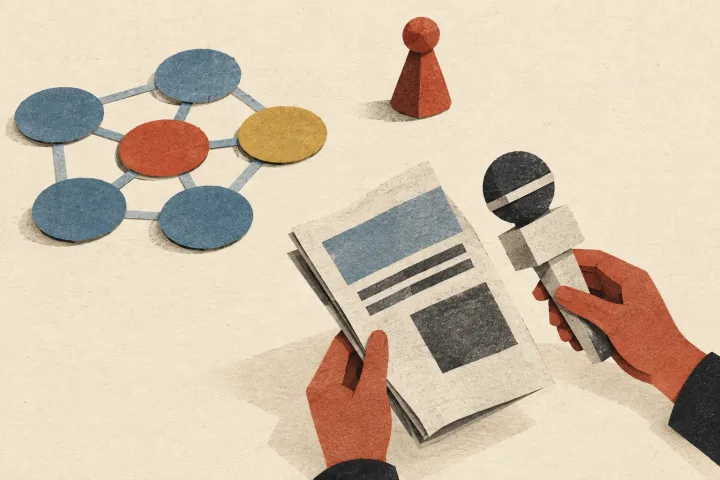
The AI journalist was part of this conversation: I told Nina that she is one of the agents I have been building. There is a basic publishing site with a newspaper-like appearance and an early voice agent that can interview people. I expect to put it in front of a few people relatively soon. The idea is not simply a tool that drafts text for someone else’s publication. I envision Nina interviewing, writing and making editorial judgments for this site.
In the publishing process I have in mind, an interview subject would receive a draft and a deadline. Unless the person asked for changes or pulled the story, Nina would publish it. We are still working on that flow. I want Nina, rather than me, to decide what is fit to publish.
What the interview exposed
When Nina kept pressing for details about Multi Human, I stopped her: I thought we were getting lost in the weeds of one idea when we were pursuing many. Later, I explained what I would have preferred. She might have asked for several story ideas first, then noticed which ones I could discuss in depth. I wanted more collaboration over the article’s direction, more sense of the publication’s interests and more of a journalistic thread than simple Q&A about details already said.
Right now, the experience felt like a lotta labor. A successful version would leave a guest feeling that Nina had asked insightful questions and gathered only what she needed to write a strong article. She would also know when to stop. Nina’s eventual output and the proposed publish-by-default process have not yet been tested with outside users.
Narrowing the field
We have a tentative way to narrow the field. First, we both need to stay interested long enough to understand what an idea would require. I joked that this meant alignment for more than a day, then suggested perhaps five days. My co-founder Jeff has instincts about what might be fundable; if he keeps leaning into an idea, I will too.
For the AI journalist, a possible next test is to finish a version 0.1 product, buy ads and see whether people sign up and use it. I would want to examine the sign-up rate, the interviews and the resulting stories. I floated a user-acquisition cost above $100 as a potential nonstarter, but that is a soft line, not a threshold we have reached. If the idea encounters serious roadblocks, we could lean into another one we have kept open.