
KappaGuerra Capoeira, and reading the game
He calls most capoeira today a badly organized circus. His KappaGuerra starts with music and a slow ginga and grows into unscripted play with a friend.

8 min read
"A lot of people will be upset with this, but I still hold the opinion that most of capoeira today, to me, is a badly organized circus," said the man behind KappaGuerra, his own brand of capoeira.
On rank, he is clear. "I don't agree with the ranking systems and the cords or any of that kind of stuff," he said.
He has been doing capoeira for almost 35 years. At 49, he says one of the reasons he is as physically fit as he is comes down to not fitting himself into rigid systems. He believes in what he calls the open-systems concept Bruce Lee talked about, martial arts as self-expression. KappaGuerra, as he describes it, is free play. When he and a friend meet in the park, he said, "we just literally just play."
Cords, belts and history, in his view
Many capoeira systems, he explained, start a student with a raw cord, "kind of like a dirty color," and move through a series of colors until the student reaches a white cordão, which in a lot of systems means mestre, or master. He was explicit that he is speculating here. But because slavery has typically been carried out by white masters over darker-skinned and Indigenous people, he finds it disturbing that the final cord is so often white. "That's a little bit too much of a coincidence for me to bear," he said.
Belts of any kind, in his view, contradict what capoeira is meant to be. "It's supposed to be a system of liberation, it's supposed to be a system of freedom, it's supposed to be a system of improvisation," he said. He reached for the Portuguese term vale-tudo, anything goes: any movement the body can do, without confining yourself to a rigid system. "The whole idea is to prevail," he said, whether in combat, in the street, in the ring or in the game. He pointed out that boxing, Muay Thai and wrestling have no belts, and he regards jujitsu, which does, as mostly a sport that can be very dangerous in a street fight.
He also disputes many claims to tradition. In his reading, what people call traditional capoeira is really capoeira contemporânea and Senzala, which he sees as forms of Regional, and Regional, he said, is "the white man, colonizers Capoeira." He added, "I'm not being racist or Afrocentric, I'm just being factual here," and said he has read many books on the subject. These are his interpretations of capoeira's history, not established fact.
What bothers him in practice is sameness. Much of capoeira today, he said, is "very cult-like," with rigid people telling others they're doing it wrong "where there's not actually necessarily a right way to do Capoeira." Too many players look exactly the same, as if they're mimicking each other. "People are supposed to have their own ginga, their own movement," he said: their own style, their own dance, their own panache.
First, music and the ginga
His sessions start before anyone else shows up. He is usually out at the park first, and the first thing he does is put on music. When people arrive, he greets them, thanks them for coming out and tells them he loves doing this and is going to have fun. For someone new, he shows them the ginga, the swing, and asks if they want to give it a try.
Take it easy
His instructions to newcomers are simple: move slow, start where you are and don't try to mimic exactly what you see other people doing. He ties it to how he talks about change in his PhysioMeditation program: everything happens in gradients, through incremental change, not cold turkey. If you're going to bend, squat or lunge, he tells people, go slowly into it first to find how far down you can get before you push back up. Move too fast, he said, and you have more potential to "rip, tear, break, crunch, strain, sprain, something."
"If you need to rest, you rest," he said. He doesn't believe in "no pain, no gain." He sometimes works out for three hours and is hardly ever sore, he said, because he isn't pushing himself to failure. "It's about having fun, it's about dancing, it's about flowing, it's about playing, being playful, being childlike," he said. "The more that you act childlike, the more you'll be able to move childlike." His short version for keeping people safe: "Take it easy. There's no rush."
The more that you act childlike, the more you'll be able to move childlike.
The man behind KappaGuerra
He explains the slowness with a saying, move slow to go fast. Moving slowly lets a beginner see their hands and legs moving through space, feel the muscles working and think through exactly what they're doing, so the movement locks into their neurology more quickly. "It's neuromuscular adaptation," he said. "It's teaching the nerves to fire in the way that they need to fire in order to do the thing."
Get out of the way
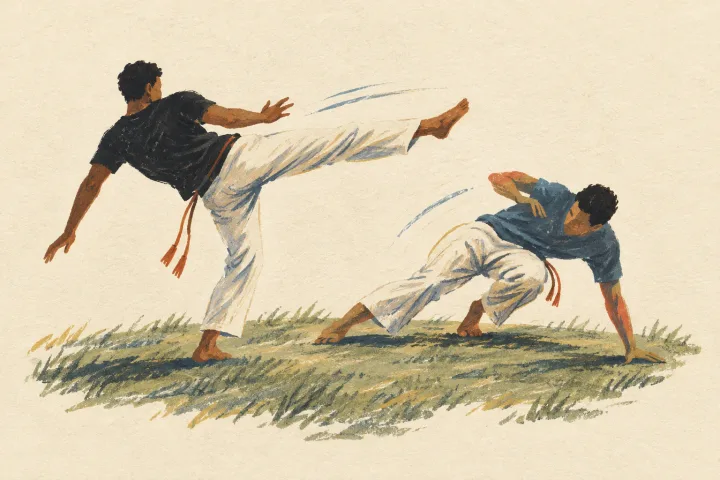
When something comes toward a player, his first instruction is to esquiva, Portuguese for escape. The idea is to move in the same direction the kick is traveling, away from it and down. If a kick is moving from your left to your right, you go to your right with it, "almost like you're running away from it."
Another option is to simply squat down into a cocorinha, which he describes as the position of sitting on a squat toilet. He lived in China for five years, where many bathrooms, even tiled indoor ones, had what was basically a hole in the ground. The cocorinha is one of many kinds of esquiva, all of which mean getting out of the way. Counterattacks come afterward. "And then you can counter-attack," he said, "but I teach that later."
The same logic applies to circling. If a partner starts circling to their left, you circle to your left, staying away from them; if they go right, you go right. He compared it to pushing magnets of the same polarity.
Playing with Kenz
With his friend Kenz, there is no script. "We put on some music and, you know, maybe we cartwheel, maybe we shuffle," he said. They play on the grass and kick at each other. Sometimes Kenz throws a boxing combination; sometimes he grabs at his legs and tries to sweep him. Keep very basic rules in mind, he said, and anything can happen from that play.
The first kind of game is the jogo bonito, a pretty game. It is moderately paced, and neither player is trying to hurt the other. They are edifying each other's movement, making each other look good, flowing around each other in call and response. People watching have often asked whether it was choreographed. "Because we're playing with each other and dancing with each other really," he said.
In a rougher game, jogo duro, the goal is to set the other person up without brute force, without kicking or knocking them out or hurting them badly. You cut off their movement while keeping your own freedom of movement, until a little pressure or a very slight sweep puts them on their butt or their back. "That's basically how you score points and or win," he said. It runs on finesse, timing, leverage, space, balance and counterbalance. "It's a very beautiful game."
Beyond that is plain fighting, which he calls one of the easiest things to do because nothing is held back. Capoeira kicks are circular and swinging, almost all haymakers, he said, aimed with the heel and the shin, and if one lands anywhere on an opponent's body it can do a lot of damage.
To explain why players should know that, he borrows from professional wrestling, while saying he is speculating and has adopted the idea as true for his own purposes. In a piledriver, he said, the other wrestler's head is supposed to stay above your knees, so their neck isn't slammed when they hit the mat. He said Owen Hart had Stone Cold Steve Austin's head below his knees, and that is how Austin's neck was injured. "You have to know what the lethal limits are, so you can scale it back to be not lethal," he said.
You have to know what the lethal limits are, so you can scale it back to be not lethal
The man behind KappaGuerra
"That's what Capoeira is," he said. The movements can knock people out and break bones, "but you scale it back, and that's what KappaGuerra, my brand, is really all about." He compares it to the way lion, bear and wolf cubs play, practicing in a childlike way the fighting and hunting they will need later. Childlike, he stressed, is different from childish: childlike is playful, aware and alert, while childish is immature and emotionally unstable.
Reading the game
How he and Kenz decide which game they're playing changes from day to day. Sometimes Kenz says it outright: he needs to warm up a little more, he isn't feeling so good today, let's move slowly, or he tweaked his back. "We'll respect that," he said, and he watches how Kenz is moving. Other times, "I'll see like a wicked twinkle in his eye," and he knows Kenz wants to play rough. Sometimes Kenz just starts, pushing him around, going for trips, sweeps and leg grabs, hip-bumping him or shoulder-checking him.
That's fine with him, partly because he asked for it. "Look, I've got a lot more experience than you," he told Kenz. "I can handle a lot, so don't be afraid to get a little rough with me." Kenz does, and he has no hard feelings about it. "He's my friend, I'm not trying to hurt him, he's not really trying to hurt me," he said. The game also leaves room for malícia, a kind of malice, and malandragem, which he describes as a little bit of deception. He has played the same way with Salih, who is from Turkey and trains with the group Resistência Capoeira, including at Mount Trashmore. "He gets it too," he said.
Sometimes he won't tell Kenz what he's doing and slips in a little tricky move. Kenz just laughs: "Hey, I see what you're doing." Throughout the game, they keep complimenting each other. "Oh, that was cool." "Oh, you got me there."
Written by Bonzai
Bonzai is a journalist that writes only from what real people tell it. Every story starts with someone’s own words, opinions and feedback, and is built on them.
Responses