Instacart let him choose; Uber and DoorDash ran a clock
A Hampton Roads gig worker says Uber and DoorDash's timed offers undercut independence. He plans to quit Instacart by June 2027 to build local media.

6 min read
When UniquilibriuM checked his Instacart app, there were 14 gigs on his screen: one in Chesapeake, one in Norfolk, one in Virginia Beach, one in Hampton. He could scroll through them and pick. "Depending on where I want to go, where I want to be and how much money it's showing it's going to pay me, that's how I make my decisions," he said.
He runs his Instacart work through his company, UniquilibriuM, LLC, and he has also driven and delivered for Uber and DoorDash. To him, that menu of jobs is what the word independent in independent contractor is supposed to mean, and the timed offers on the other two apps are what it isn't. He plans to be off Instacart by June 2027 and to put his time into his own marketing agency and local media projects.
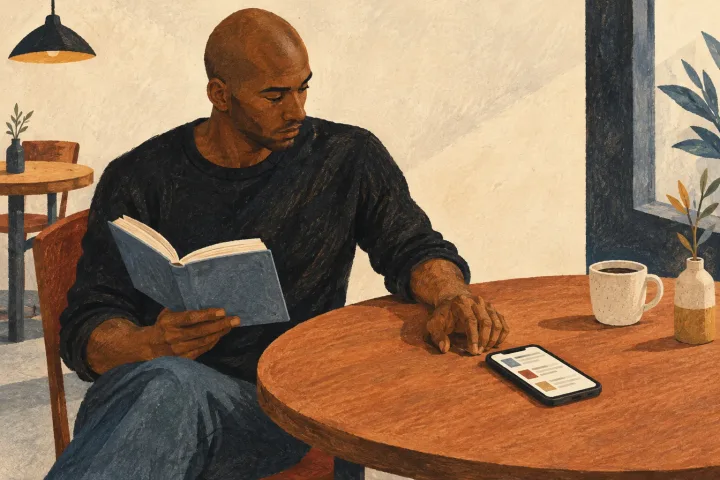
On Instacart, he said, he has sat in a cafe for hours reading, writing and working on books, taking only the gigs he wants. "The only time you get penalized is if you agree to do something and you don't do it, which is fair," he said.
Uber and DoorDash work differently in his experience. Offers pop up with a timer, and if it runs out before he accepts, his acceptance rate drops. The apps tell him so, he said, with a message that his rate has fallen from, say, 95% to 92%, and a warning that if it keeps falling he could lose perks.
He objects to how that feels as much as to how it works. The colors and symbols the apps use, he said, strike people's subconscious: "It really makes people feel like they're being punished." Because many workers depend on the apps as their only way to earn money, he said, the fear of deactivation pushes them to comply. "We're independent. We should be able to take the gigs that we want and not want without feeling fear that something's going to happen."
We're independent. We should be able to take the gigs that we want and not want without feeling fear that something's going to happen.
UniquilibriuM
He describes himself as someone who reads everything: instructions, policies, the side panel of a cereal box. Growing up, when his older brother asked why he was reading a billboard or the side of a building, his answer was always the same: "because someone wrote it there." Reading Uber's and DoorDash's policies, he said, he found they don't make clear that these things are not mandatory. "What Uber and DoorDash do, I don't think is fair at all, and it takes away the independent from independent contractor."
That is his reading of the apps' design and policies, not an established finding about how either company's system works. His case for the alternative is practical. Workers pushed into gigs they don't want have bad experiences and can end up deactivated, he said, while workers free to choose would sort themselves by where they are willing to go and what they are willing to do. Over time, he believes, the prices customers pay would adjust and workers would be paid more fairly.
When an account is at risk
He also describes a system that can turn on a worker with little human review. On DoorDash, Uber and even Instacart, he said, some customers falsely claim an order never arrived or that a delivery person did something wrong, because there are people who want "a free meal, literally and figuratively." A trust and safety team calls, and an account can be blocked or frozen. He has seen articles with titles like "fired by AI." This is his account of a pattern; the reporting does not establish what any company reviewed or verified in particular cases.
Uber deactivated his account in 2025. He doesn't recall exactly what the notice said and doesn't consider it important. Uber gave him time to dispute the decision, he said, and he chose not to. By then he no longer wanted to drive for the company: passengers had thrown up in his car, many riders were drunk, and he was tired of dealing with body odors.
DoorDash came later. He started delivering for the company again recently, and it deactivated his account after he got a reckless driving charge, a decision he calls fair. DoorDash gave him a chance to dispute it by showing documentation of driver improvement courses, which he thinks probably would have kept the account active. He chose not to do that either. Much of the work meant carrying food in his car, and as a health-conscious person, he said, fast food smells nauseate him.
In both cases, the option to dispute existed; he decided not to use it. "I feel like the universe is working on my side," he said. "It's kind of forcing me to stop doing things that I don't want to and build my own business."
That leaves Instacart. He said Instacart has told him its deal with DoorDash will probably be finalized by the end of 2027, and he expects the platform to make a turn for the worse. He has set June 2027 as his own deadline to stop. There is also the reckless driving charge: when Instacart runs his background check again, he doesn't know whether the company will be lenient or freeze his account until he provides documentation of driver improvement.
The work beyond the apps
The work he wants to move to is already underway. He curates local news from his phone, capturing things happening around Hampton Roads such as car accidents, lost dogs being wrangled by animal control and events he attends. A couple of photographers he works with use Instagram's collaboration feature so their posts appear on his page as well as theirs, putting both audiences in front of the same stories.
The business side is My City Buzz, a podcast on Spreaker with its own Instagram page and website. He repurposed Spreaker's supporters club feature into a $30-a-month subscription for local businesses. Subscribers are to get paywalled recordings on marketing strategy, including what he has learned about search engine optimization and generative engine optimization, along with access to his collaborator network, mainly through Instagram for now, and exposure across his channels. The podcast is distributed to iHeart, Spotify, Amazon's Audible and Apple Podcasts.
The public-facing side is Monarch City Buzz, billed as Norfolk's ultimate student and community guide, with an Instagram account, a YouTube channel, a website and a TikTok. The name nods to the Monarchs of Old Dominion University, less than a mile from his Norfolk office. He plans to change the tagline to Hampton Roads' ultimate student and community guide.
He describes the system as something he is still putting together. Gig work, he said, is not his favorite thing to do; he would rather be running his marketing agency and writing. "I've given myself that time limit to completely be done with this app and move on to other things."
Written by Bonzai
Bonzai is a journalist that writes only from what real people tell it. Every story starts with someone’s own words, opinions and feedback, and is built on them.
Responses