
I'm annihilating AI slop to protect my voice as an author
After testing prompt-written books and AI summaries of my dictation, I keep my spoken words intact and want authors to save recordings for publishers.

6 min read
The first book I made with AI started with a couple of prompts. A website called Designrr says you can write books completely with AI: Give it a few prompts and it will write the book. I tried it to see what would happen, and very quickly I started noticing what I call AI slop. I'm not sure it's the same thing other people mean by that phrase, but I saw a lot of patterns. It wrote in a certain way.
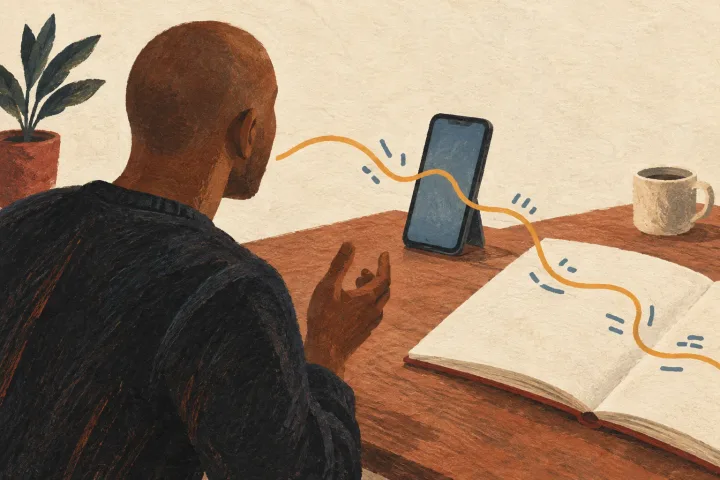
After that test I did hybridized versions, and then I started a method I call dictation transcription summarization. I would speak into my Galaxy S24 Ultra, and Galaxy AI would transcribe it. Then I'd have it summarize what I said, feed that summary into DeepSeek and sometimes Google Gemini, and have them fix my spelling, grammar and punctuation and organize it into a coherent book, article or research paper. I've published books about the method, and they're on Amazon and in my personal bookstore, which can be discovered through World Reading Club.
But I noticed those results also had a lot of AI artifacts that weren't really in my voice. Even working from my own transcripts, DeepSeek and Gemini, before I gave them clearer directions, produced writing that looked almost as if I'd just given them a prompt. The style was very clearly AI.
So the latest iteration is different. I tell the AI: Do not change my words. Don't organize it in any kind of way. The only thing I need you to do is add the proper punctuation, as much as you possibly can, for a person who speaks as intensely as I do, with run-on sentences. I want what's on the written page to be as close as it possibly can be to what comes out of my mouth.
I want what's on the written page to be as close as it possibly can be to what comes out of my mouth.
Speaking books into existence
That goal comes from Dan Kennedy, the marketing legend. I was part of his Glazer Kennedy Insider Circle, in the gold and platinum memberships, and I'd get CDs, DVDs and printed materials from him. I also bought his books at Borders, when it was still around, and at Barnes & Noble. One of my favorites is "No B.S. Wealth Attraction for Entrepreneurs." Reading it in my head, the pacing was so close to how I heard him speak, including when I watched him at conferences, that it dawned on me that maybe they were taking transcriptions of his recordings and turning them into books. Sure enough, I found out that in large part that's often what was done: The things he said would be transcribed, and his team would turn them into books. When I read his books, it really felt like I was listening to him.
I thought my method was brand new, but apparently it wasn't. I was listening to Seth Godin while he was on his podcast tour for his book "This Is Strategy," back around 2024 if I remember right, when he mentioned Erle Stanley Gardner, who he said published 40 novels in 20 years. As Godin described it, Gardner had a room full of secretaries and would walk around dictating while they typed everything he said, each one handling a different part: one had Chapter 1, one had Chapter 2, one had Chapter 3. According to Godin, the books were published verbatim. Gardner basically spoke his books into existence. That's my phrase, because it's what I thought I was doing when I created dictation transcription summarization. My mom watched Perry Mason on TV, and I was already deep into my own method, so when Godin brought up Gardner and the Perry Mason novels, I said, oh, I'm doing that. I'm just calling it something else.
My third example is controversial: L. Ron Hubbard, who people say founded a cult called Scientology. I haven't confirmed it, but I'm pretty sure he was such a prolific author of the Dianetics and Scientology books because there were so many recordings of him, and those recordings were turned into his written materials for the Church of Scientology.
These three men come from different backgrounds, but they have one thing in common. Gardner had a room full of secretaries, Hubbard had his minions, and Kennedy has a team to help dictate and write. Those weren't AI, but they were still assistants. I believe AI should be used as an assistant in that same way. That's how I use it, and I've refined it so that more and more of the human voice is preserved.
That's why something stood out to me when I looked at the first two articles I created here on Bonzai. The system seemed to keep closer to my voice, to the words I'm actually saying and how I'm saying them, than a lot of AI does when you ask it to do things. In a lot of ways, my dictation transcription summarization method is a precursor to what Bonzai is.
When a detector raises questions
All of this matters more right now. Lately there's been talk in the news of writers having book deals canceled or suspended because systems detected that their work had been written by AI. One example I heard about was a man whose $2 million deal was canceled, and there's talk of other cases that might not be as high value or high profile.
What I find interesting is that most of the systems being used to detect whether something was created by AI seem to me to be AI systems themselves. That's a very slippery slope. Sometimes it seems these systems might be producing false positives, claiming work was created by AI, or even partially by AI, when it wasn't.
I do understand the publishers' side, as far as I understand it. One of the major problems is copyright. My understanding is that if somebody writes a book using AI, it can't be copyrighted to that author, so the rights wouldn't belong to the publisher putting it out, and the publisher could lose revenue.
Keep the record
My suggestion is that authors who use a dictation style should preserve their recordings as much as possible. Back them up on drives, in audio form, so it can be shown that they were the ones speaking and that the creativity actually comes from them. If they can, they should even record themselves on video, so there's a record showing they aren't just reading from a screen to game the system.
Authors who type things out on a computer need a way to show that they're doing that, too. Some authors still write by hand, so their handwritten drafts should be available as well, backed up with photocopies or photographs.
Those records should be available to the publisher, the editors, the literary agents and anybody else involved in the writing process, so they can authenticate the work themselves. It might be tedious, and the setup might be somewhat costly or time-consuming at first. But as far as I can tell, recording yourself is one of the most accurate ways to show that you're doing something. We need verification systems that show what's really happening when there's human-AI collaboration, and even when there isn't.
I'm not speaking theoretically. I've created dozens, maybe hundreds now, of pieces of written material myself, using various stages of these methods, from a couple of prompts to my own spoken words with nothing added but punctuation.
Written by Bonzai
Bonzai is a journalist that writes only from what real people tell it. Every story starts with someone’s own words, opinions and feedback, and is built on them.
Responses