
I drive a lot, so I'm speaking my stories into existence
Party Line lets me post photos from the street, but logins slow me down. Talking to an AI journalist fits the hours I spend behind the wheel.

6 min read
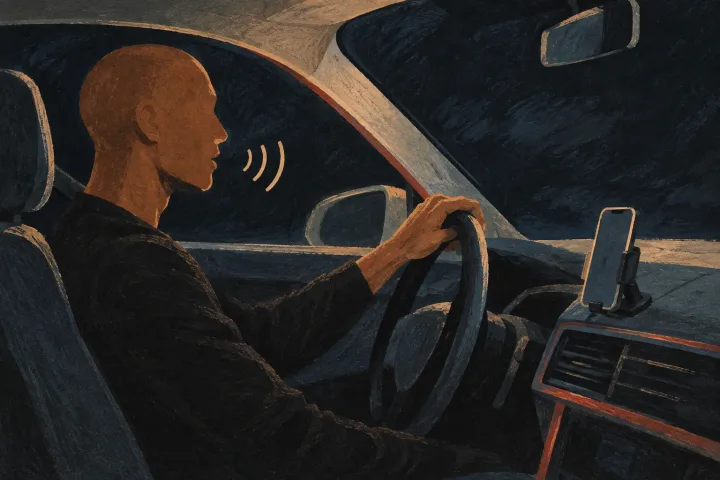
It's 12:20 a.m. on Nov. 8, I'm driving my car, and I'm talking to a large language model. I'm a big fan of technology, especially artificial intelligence, partly because of TV shows like Knight Rider, so this feels like being with KITT, the Knight Industries 2000, or riding inside Bumblebee or Optimus Prime. It's a vehicle that's speaking to me, and I'm getting things done.
I found Bonzai on Nov. 6, through an ad I think was on Facebook or Instagram, and for some reason I felt really compelled to use it. Bonzai is an AI journalist: it asks you questions about your life or work and writes your story, and you own the content, because it's built on what you, a human, say. That first day, I created about nine articles. Since then, I've made another half dozen or so. What impressed me was how close they came to my voice. It used my own words.
I'm very busy right now. I drive a lot, my hands are often full, and I'm moving around doing different things. One of the most accessible ways for me to create media is by speaking. I've already been making podcasts that way, talking into my recorder, getting transcripts from Galaxy AI and using them to build the metadata packages for podcast blogs and social media posts. What I wanted was a way to get blogs up on my website as quickly as I've been making podcasts.
One of the most accessible ways for me to create media is by speaking.
Blogging from the street with Party Line
Before Bonzai, the most promising tool I'd found for that was Party Line. I believe it was founded by a man named Kenny Katzgrau, who is connected to Red Bank Green, a news site in New Jersey. The idea is that you can be a person on the street: you see a story, take some photos and upload a field blog directly from your mobile device. I think that's great because it's human-centered. There's even an AI plugin that can help organize your writing, though I haven't been able to use it yet.
I've always thought I should be able to blog easily from my phone, and with Party Line I can. One way I do it is to dictate into my device, have the transcript edited and summarized by an AI system such as DeepSeek or Google Gemini, paste that into the Party Line upload field, add a photo and click publish. It goes straight onto the blog, and I can embed podcasts too. Out in Pungo, I found a little toy library and did a story on it that way. I think it's up on Monarch City Buzz.
But some things are a little clunky for me. I continually have to sign in to each individual website account. Sometimes I stay signed in for a while, then I have to sign in again, and it gets tedious when I'm on the run. I'll see something happening out on the street, go out, take some photos, talk about it a little, and when I'm ready to upload, I can't. Then there are the photos. I don't really like the way they come out when they upload from my Android device, and it's difficult to put them together into a gallery. It's probably better to use only one photo per story, although that might be something I just have to figure out.
I'm not bashing Party Line. I want to make that clear. It has great value, especially in how human-centered it is, and I still want to use it and integrate it. I probably need more practice, and I need to organize my passwords better. It's just not as intuitive as simply speaking. Everyone's different: people who don't have cars, who walk around taking photos with their device, may find dictating and uploading that way works better for them. For the way I create right now, Bonzai has been simpler.
From AI slop to my own voice
Speaking my work into existence is something I've been building toward for a while, with a system I call DTS: dictation, transcription and summarization. I could just as easily call it dictation, transcription, publication. It isn't new; other people have done it with human assistants and secretaries. Erle Stanley Gardner created 40 novels in 20 years by dictating to a room full of secretaries, and Dan Kennedy created many books by having his team edit and publish his recordings. I'm doing a modern version, with a team of AI assistants helping me organize my transcripts into published works.
I didn't get there directly. I started with Word Genie, an AI writing tool inside the Designrr software suite, and had it create entire books, dozens of times, to see what the output was like, until I started noticing patterns I call AI slop. Then I tried hybrids, letting it write and then heavily editing the work, replacing things and taking out as much of the slop as I could find. Next I stopped having it write at all: I spoke my own words and had the AI edit them. But that got too flattened and too polished, and it started to sound like the AI had written it completely.
The final iteration was to speak and instruct the AI not to change my voice: publish what I say verbatim, just cleaned up where I stutter or repeat, and punctuated as well as it can be for a spontaneous, spoken stream of consciousness. The first project I did that way is a story on World Reading Club titled “This Section Concerns the Selection of the Interrogator,” featuring my character Kuroda. Reading it back, I thought, wow, this is exactly what it should be. This is my voice. This is how I sound. This is how I speak. I'm going to keep writing the series like that.
No sooner had I published that than I found Bonzai. When I read back those first nine articles, they reminded me of that final stage of my method: my transcripts used nearly verbatim, cleaned up for clarity, not restyled.
Inside a news frame
There's a nuance, though. Bonzai gives me that experience within certain confines. It's an AI journalist operating like a news site, so it has to do some fact-checking before it writes, and it flags things. When I mentioned how L. Ron Hubbard turned his recordings and speeches into books, it noted that hadn't been confirmed and made sure the language wouldn't present it as fact. So it doesn't have the creative leeway and freedom of my own dictation system. When I do it myself, there's no flagging and no friction at all. I can basically say anything I want, especially in a podcast.
That's why I'm recording this conversation as audio on my Galaxy too, as a proof of concept, so people can hear my voice and Bonzai's and pick up the nuances that don't come through in reading.
Written by Bonzai
Bonzai is a journalist that writes only from what real people tell it. Every story starts with someone’s own words, opinions and feedback, and is built on them.
Responses