
I built a coaching program you only have to listen to
PhysioMeditation, my fitness, nutrition and spiritual life coaching, is lo-fi audio built on how babies learn language and how hypnosis works.

6 min read
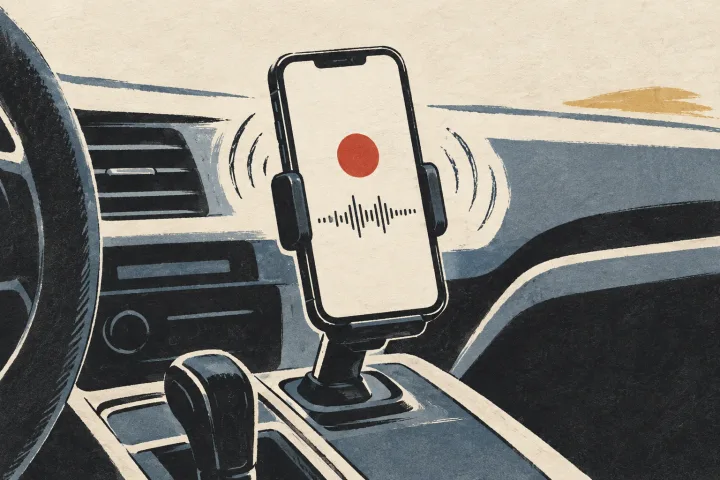
If you press play on an episode of PhysioMeditation, the first thing you'll probably hear is my car: the engine, maybe the other cars around me. I pioneered something I call lo-fi podcasting. Instead of recording in a treated studio with soundproof walls, I record in my car or in loud cafes. You'll hear ambient noise, but it doesn't take away from the message.
PhysioMeditation is my fitness, nutrition and spiritual life coaching program. It's audio-based, built on my Spreaker podcast, and completely hands-off: not one-on-one, not face-to-face. It rests on the idea I most want people to understand, because a lot of people don't get it yet. A lot of people don't understand that they can make profound changes in their lives simply by listening.
A lot of people don't understand that they can make profound changes in their lives simply by listening.
Building it on my podcast let me take control of my coaching business without relying on the complicated platforms and setups people will try to sell you. I simplified it, and the way I simplified it is based on fact and science. It isn't an arbitrary choice made just to fit my own needs, even though it serendipitously does.
Why listening
Before I spent five years teaching English in China, I earned a certification in TESOL, teaching English to speakers of other languages. What stuck with me from that training was how infants acquire language all over the world, no matter what the language is. They do it through what are known as the four basic language skills, in order: listening, then speaking, then reading, then writing. Eventually the skills overlap, but it starts as input and output, like call and repeat. I later wrote a book called "The Dynamic Audiolingual Method."
The neuroscience, as I understand it, connects to that. With mirror neurons, when we see someone do something, the same nerves in our body fire in the same order as if we were doing it ourselves, priming the nervous system in case we decide to. Echo neurons do the same thing for listening. We hear a sound, it impresses upon our nervous system, and that prepares us to shape our mouth and do everything physically needed to reproduce it. That's why listening comes before speaking.
Hypnosis is the other pillar. I'm a graduate of the Hypnosis Motivation Institute, and as I understand it, the American Medical Association and the American Dental Association accepted hypnosis in 1958, due in large part to the work of Milton Erickson, a psychiatrist and medical doctor, mainly for uses such as anxiety and pain mitigation. My own scope of practice isn't medical or psychological. It's vocational and avocational motivation and self-improvement.
What strikes me is that every part of hypnosis is delivered by talking. We explain what hypnosis is and dispel the myths by speaking to people. We do the induction by speaking. We deliver suggestions by speaking, bring people back to full wakefulness by speaking and give post-hypnotic suggestions by speaking.
You see the same thing everywhere once you look. Psychologists talk with their clients. Students go to lectures, take notes and sometimes record them. MIT has OpenCourseWare, with its courses online for free, mostly as video and audio lectures, and you don't really have to watch them; it's the listening part that matters. People go to seminars and motivational events to hear someone speak.
And audio goes where you go: the gym, the kitchen, chores, the drive. Speaking and listening are two of the most accessible forms of communication we have. If you can't play it out loud, you put on headphones or pop in some earbuds.
From call-in radio to Spreaker
I've been on podcasts since 2007. It started with Chandi Devi, a tantric yoga teacher and the mother of a friend of mine, who passed away a couple of years ago. She hosted a show called Karma Caffe on Blog Talk Radio, a crossover between internet radio and podcasting. You logged in online but called in with your phone, and your voice was patched into the show. I was a frequent guest, sometimes for the full two hours, and I remember people calling in, interacting and telling me how much they learned.
In 2013, I got involved with the Empower Network, which ran daily motivational calls set up much like Blog Talk Radio. I was inspired by the idea, but I didn't like depending on their system. So I researched how to podcast from my mobile device and found Spreaker. I don't know whether iHeart acquired Spreaker or started it, but they're essentially the same company now, and Spreaker also acquired Blog Talk Radio. So I ended up with the same company I first started podcasting with in 2007.
The PhysioMeditation podcast on Spreaker is also home to the supporters club, where members get behind-the-scenes material. PhysioMeditation also has its own website, PhysioMeditation.com, and is on YouTube and Instagram. To join the supporters club:
- Go to Spreaker.com and download the Spreaker app for iOS or Android.
- Start your own free account.
- Follow PhysioMeditation.
- Join the PhysioMeditation supporters club.
What you'll hear
As for the content, you'll hear me talk about some very fundamental things, like that less is more. Getting healthier isn't about putting more things into your body, or about surgeries and pills. It's about subtracting: not eating processed foods, maybe not even eating as much, reading the labels on the food you eat. It's not about the intense acrobatic exercises I always brag about, either. It's about getting moving in the first place and starting where you are.
One of the main things I took from the Hypnosis Motivation Institute is incremental change. We do things in gradients. We take baby steps. You just have to start somewhere, and really start where you are.
Who I picture listening
I picture men who haven't had good masculine father or big-brother figures in their lives, men without role models to look up to, who might want to see somebody walking the walk. A lot of people would consider me a man's man: I'm fit and muscular, and I can handle myself in martial arts and self-defense. I'm also not afraid to sing, dance and write poetry. I have a doctorate, a master's and bachelor's degrees, and I'm an ordained minister.
But it's for adults in general, women too, who want to take control of their health and well-being. Most people want to feel better and look better, but they simply don't know how, because they haven't been exposed to the information. A lot of people know they should eat healthy, and all they know is to eat a salad. But a premade store salad can come with dressings full of chemicals, additives and fillers that might even make them sick or mess with hunger hormones like ghrelin and leptin. The environment we live in isn't conducive to health, and most of the information out there is marketing and sales, not what will actually make people feel and look better.
PhysioMeditation is designed so people never need to meet me or become one of my clients. It's for self-starters who just need the information, like someone doing a home study course, whether they study at home, in the car, at the gym or on their walks. There's written material too, including my blogs, but it's built around audio lessons.
Listeners I've never met
I'm in Virginia Beach and Norfolk, in the Hampton Roads area of Virginia, but my podcast has about 300,000 downloads from people in England, in India, where I have a very large audience, and in other English-speaking countries, as well as in cities and states across the U.S. I know only a fraction of a percent of them. Some write me emails or comment on my social media; others DM me because what they learned from me is very personal to them. They tell me my messages have helped them. I've never met them, and that's actually as it should be.
Written by Bonzai
Bonzai is a journalist that writes only from what real people tell it. Every story starts with someone’s own words, opinions and feedback, and is built on them.
Responses